A falcon on a leather glove, a person waiting, and the moment the bird takes off. That same moment has played out on the steppes of Asia, at the imperial courts of China and Baghdad, and in Danish fields. According to UNESCO, falconry has been practised for over 4,000 years and is one of the oldest relationships between humans and birds 17. In 2010, falconry was inscribed on UNESCO's list of the Intangible Cultural Heritage of Humanity 2.
This page explains what UNESCO has recognised, how falconry spread across the world, the traces it has left in the Nordic countries and Denmark – and what it means today.
Numbers in [ ] refer to the numbered list of sources at the bottom of the page.
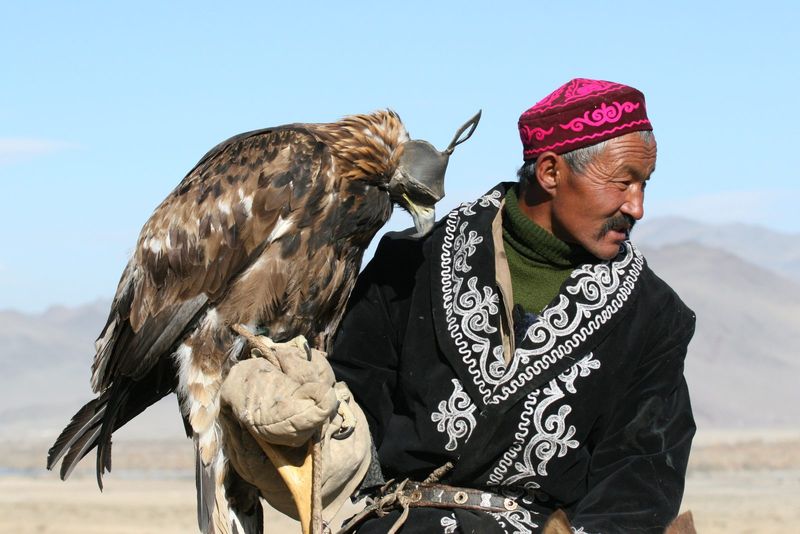
What has UNESCO recognised?
UNESCO describes falconry as the traditional art and practice of training and flying falcons – and sometimes eagles, hawks, buzzards and other birds of prey 1. Originally a means of obtaining food, it has over time also become a social practice and a way of connecting with nature 1.
What is inscribed is not a place but knowledge and skills: breeding, training and caring for the birds, the equipment, and the bond between falconer and bird 1. According to UNESCO, falconry is passed on through mentoring, within families and in clubs, and modern falconry focuses on safeguarding falcons, quarry and habitats 1. When inscribing it in 2010, UNESCO stressed that falconry is a social tradition that respects nature and gives its practitioners a sense of belonging, continuity and identity 2.
↑ Back to topThe 24 countries on the list
Austria · Belgium · Croatia · Czechia · France · Germany · Hungary · Ireland · Italy · Kazakhstan · Kyrgyzstan · Mongolia · Morocco · Netherlands · Pakistan · Poland · Portugal · Qatar · Republic of Korea · Saudi Arabia · Slovakia · Spain · Syrian Arab Republic · United Arab Emirates 56
- 2010: United Arab Emirates, Belgium, Czech Republic, France, Republic of Korea, Mongolia, Morocco, Qatar, Saudi Arabia, Spain and Syria 28
- 2012: + Austria and Hungary 3
- 2016: + Germany, Italy, Kazakhstan, Pakistan and Portugal 4
- 2021: + Croatia, Ireland, Kyrgyzstan, Netherlands, Poland and Slovakia 512
According to the Austrian Commission for UNESCO, it is the inscription with the most participating countries on the intangible heritage lists 11. Denmark is not among the countries on the list 15.
↑ Back to topThe earliest traces – and the disputed ones
No one knows for certain where and when falconry began. The joint 2021 UNESCO nomination states that it probably evolved in the steppes of Asia 7. Researchers point out that there is no unambiguous evidence for this 15, and that falconry may have arisen independently in several places 28.
Several ancient images are often cited as evidence but are disputed:
- Assyria, 8th century BC: A relief from the palace of Sargon II at Khorsabad was once interpreted as showing a falconer. Several scholars now reject this; the bird may be a decoy or wounded prey 14.
- The Hittites in Anatolia, 2nd millennium BC: Seals and reliefs show a figure with a bird of prey on the fist and a dead animal, mostly in a religious context. Whether they depict falconry is disputed 14.
- China, c. 3rd century BC: A falconer figure on a bronze belt buckle from north-western China is regarded by Japanese research as an early depiction; from the 2nd century AD, falconers appear on Han dynasty tomb reliefs 16.
How falconry spread – a timeline
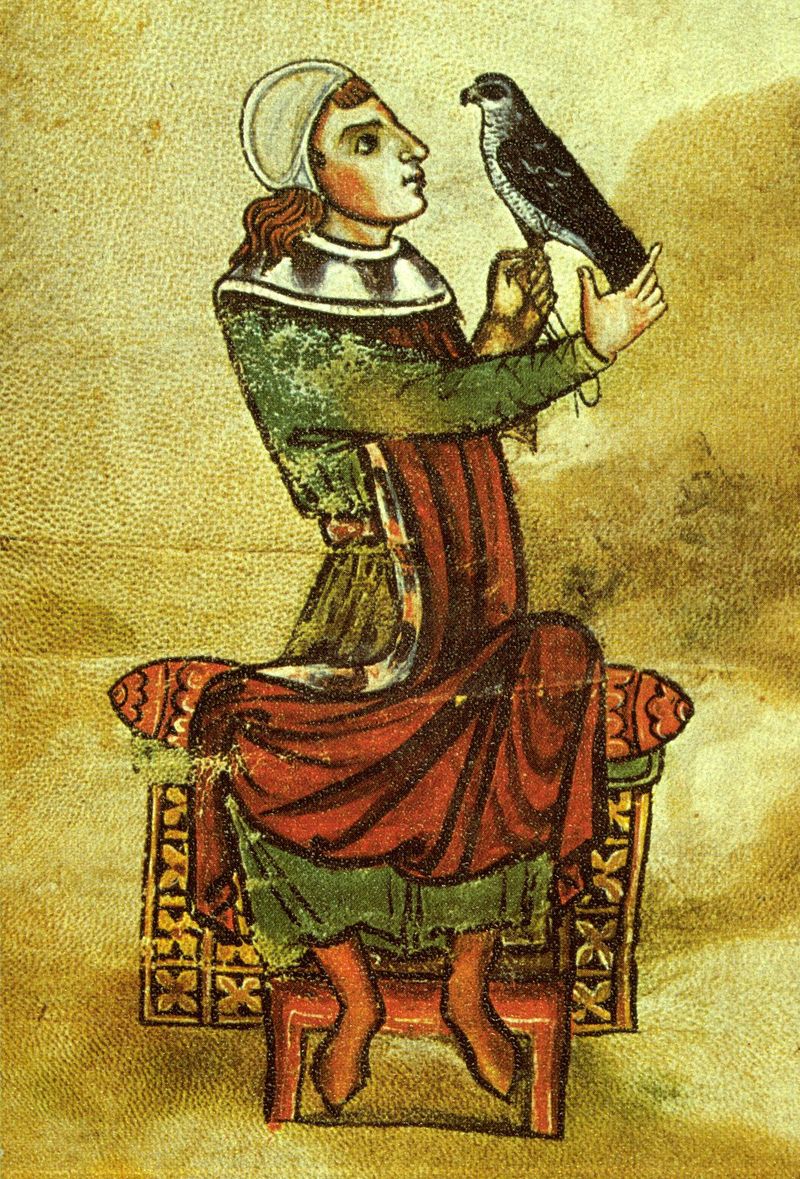
Falconry became part of some of history's greatest empires and courts. According to the UNESCO nomination, it spread via cultural and trade links to Europe, North Africa and East Asia – and in the 16th century to the rest of the world 7.
- China, Tang dynasty (618–907): In the tomb of Crown Prince Zhanghuai, a wall painting shows a hunting procession of more than 40 riders, some carrying falcons, others accompanied by dogs, cheetahs and lynxes 17.
- Korea and Japan (Goguryeo and Kofun periods): Falconry flourished in the kingdoms of Goguryeo and Baekje on the Korean peninsula and appears in Goguryeo tomb murals. In Japan, the chronicle Nihon Shoki mentions a dedicated group of royal falconers, and clay figures (haniwa) of falconers are known from the Kofun period 1819.
- Europe, c. AD 400–500: Falconry probably reached Europe from the east with the peoples of the Migration Period. The oldest known European depiction is a set of floor mosaics from a Roman villa in Argos, Greece, from around AD 500. Germanic laws set fines for stealing hunting birds, and at Quedlinburg in Germany a noblewoman of the late 5th or early 6th century was buried with a goshawk and two dogs 15.
- The Abbasid caliphs in Baghdad, 8th–10th centuries: Falconry had been known on the Arabian Peninsula before Islam, but became a major elite practice in the 8th century. The caliphs' falconers wrote manuals, and between 869 and 911 the caliphs received at least 172 falcons as gifts – many of them white 20.
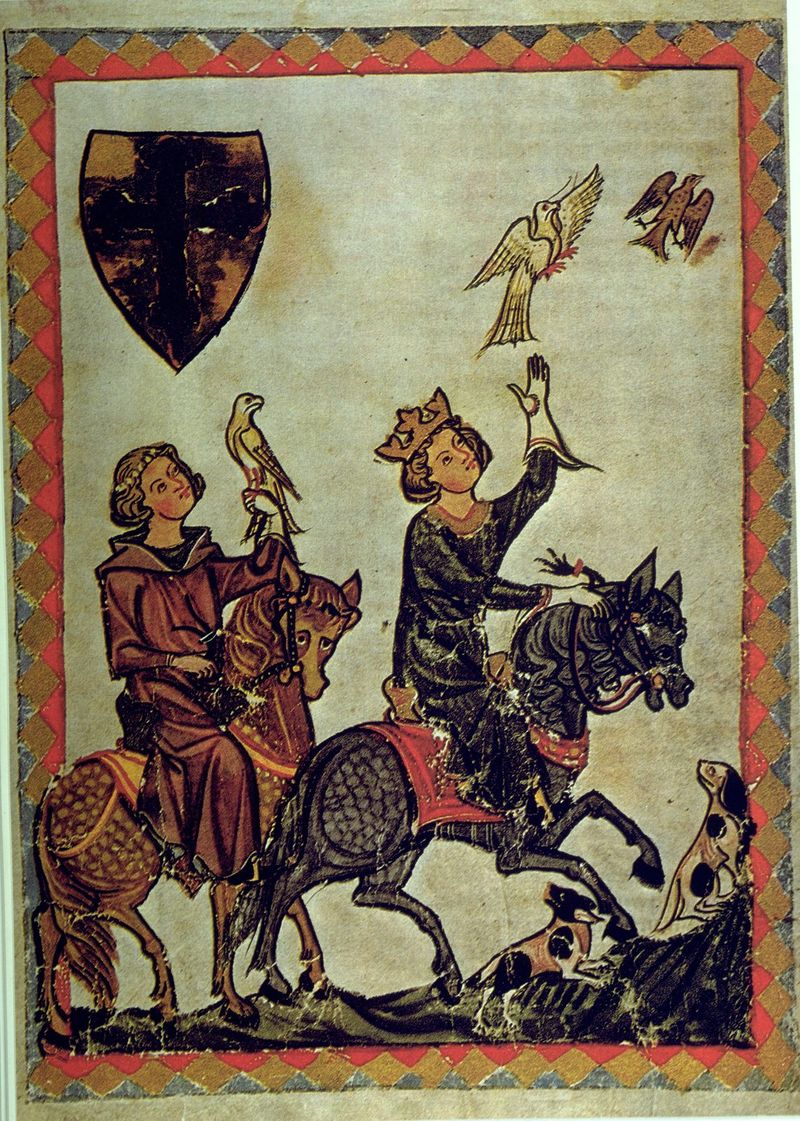
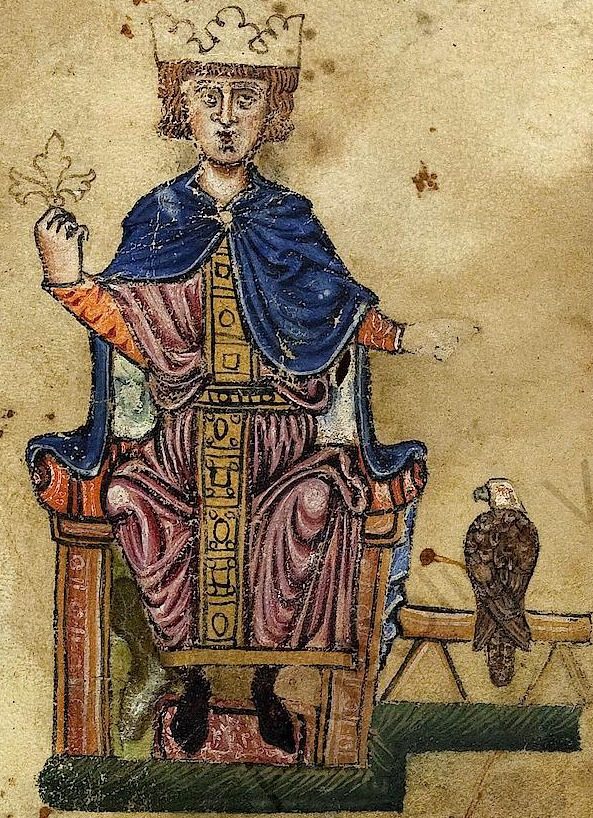
- The Holy Roman Empire, 13th century: Emperor Frederick II (1194–1250) had an Arabic falconry manual, known as Moamin, translated into Latin in 1240–41 22. His own work, De arte venandi cum avibus ("The Art of Hunting with Birds"), survives in an illustrated mid-13th-century manuscript in the Vatican Library 23.
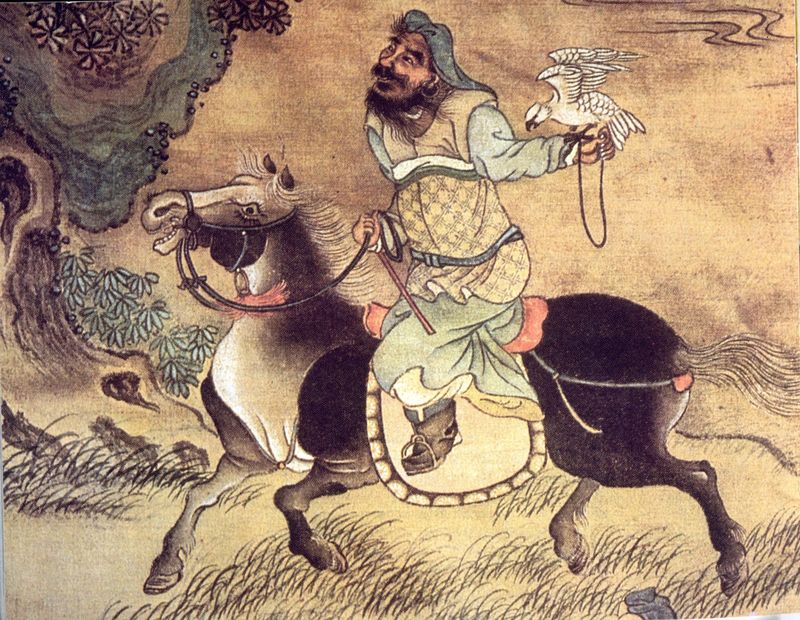
- The Mongol Empire, 13th century: According to Marco Polo, the Great Khan Kublai went hunting "attended by full ten thousand falconers" and large numbers of gyrfalcons, peregrines and sakers 21.
- The Mughal Empire in India, 16th–17th centuries: A painting from c. 1602–04 shows Emperor Akbar examining a trained falcon 25. Emperor Jahangir's chief falconer, Khan 'Alam, was also his ambassador to Iran 24.
The Nordic countries and the Vikings
In the North, the oldest evidence lies in the ground. In Sweden, around 40 high-status graves from the Vendel and Viking periods contain birds of prey – most often goshawk – mainly in central Sweden, and falconry is documented there from the 6th century 2627. An 8th-century grave at Vendel contained a gyrfalcon 20. Researchers stress that it cannot be proven that each deceased person was a falconer, but that hunting with trained raptors took place 27.
In Norway, the oldest secure evidence is the Gokstad ship burial from around AD 900. The mound contained, among other things, twelve horses, dogs and two female goshawks – the first secure find of birds of prey in a Norwegian grave 2028.
Picture stones tell the same story. The Swedish Böksta runestone (U 855) shows a rider with dogs chasing an antlered animal that is attacked by a small hunting bird 30. The Norwegian Alstad stone from the late 10th century shows riders, horses, dogs and a large bird of prey; it is most often interpreted as a hunting scene, though other interpretations have been proposed 29. In 2021, archaeologists in Oslo found a small figure of a royal falconer, probably dating from no later than around 1250 28.
The white falcons of the North – sought after from England to Egypt. The gyrfalcon was the most sought-after export, because it lives only in the far north 28. In 1225, King Haakon Haakonsson of Norway sent thirteen gyrfalcons – three white and ten grey – to Henry III of England, writing that Icelandic birds were held to be worth more than gold or silver 20. The 13th-century Norwegian text The King's Mirror (Konungs skuggsjá) describes Greenland as the land with the most white falcons 20.
Researchers have recently argued that some of the white falcons given to the caliphs in Baghdad in the 9th century were gyrfalcons from Scandinavia and Iceland, carried along Viking-Age trade routes via Rus' 20. Later, in Mamluk Egypt, buyers even paid for dead gyrfalcons to keep the risky trade going 20. Marco Polo wrote that the gyrfalcons the Christians carried east went to "the Prince of the Levant" 21.
↑ Back to top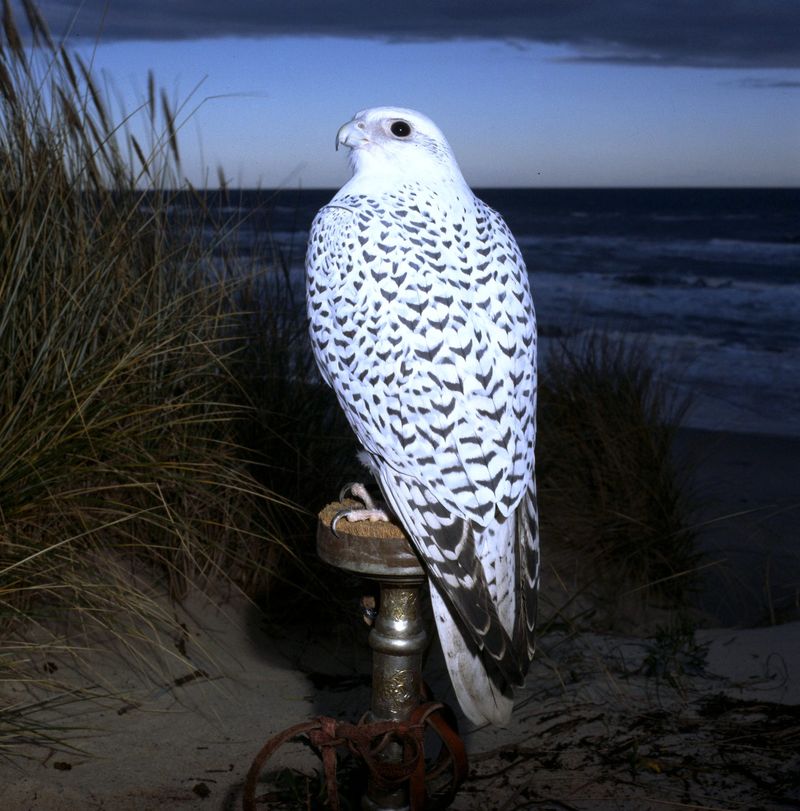
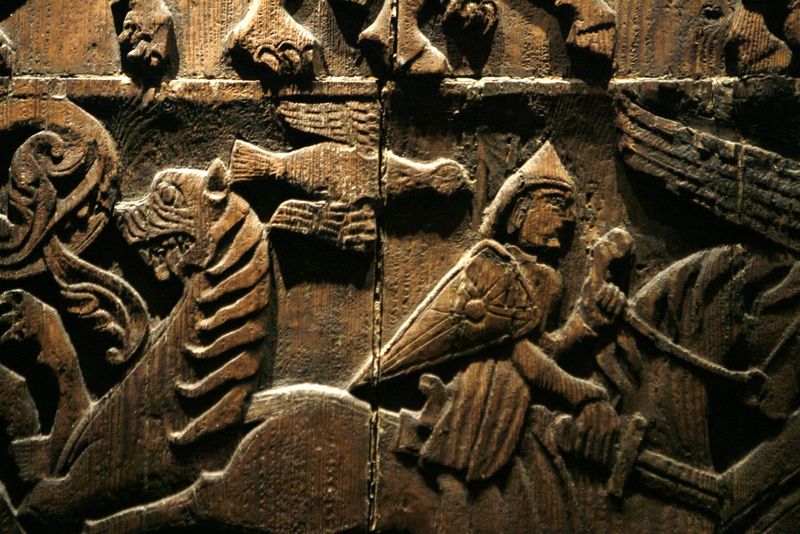
Denmark: from the Viking Age to the Royal Falconry
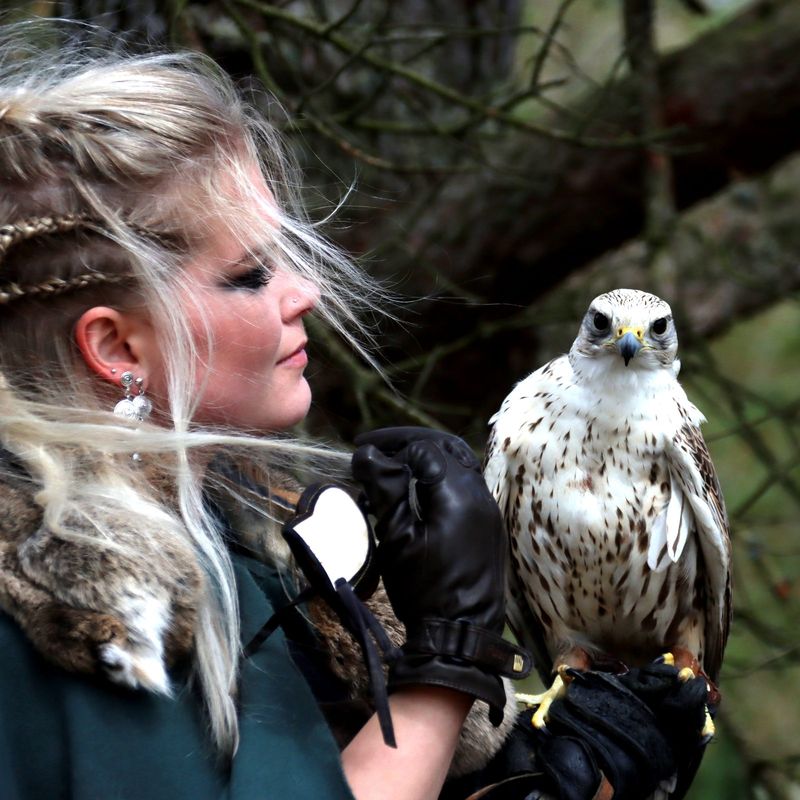
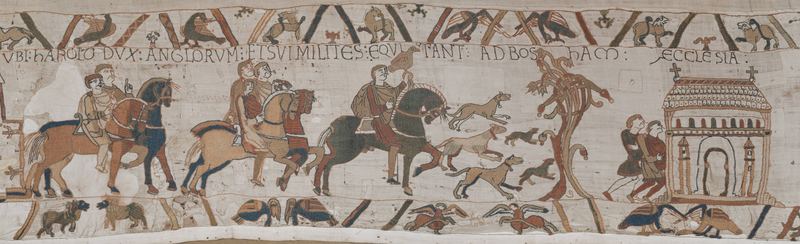
In Denmark it was not customary to bury high-ranking men with their hunting birds 31. But at Danish Viking Age settlements, peregrine falcon has been found at Trelleborg, kestrel and goshawk in Viborg, and sparrowhawk in Ribe. Together with other features of these sites, this indicates, according to zooarchaeologist Anne Birgitte Gotfredsen, that falconry was practised 3133. Small copper bells from Tissø may have been attached to a hunting bird's leg, but may also have had other uses 31. Whether falconry was practised in Denmark before the Viking Age is not securely documented; a Danish research overview examines traces from the 7th to the 17th century 32.
Legends and sagas. The oldest written stories about Danish kings and hunting birds are legends and sagas, written down several centuries after the events they describe. They cannot be read as reliable history. The legendary king Rolf Krake (Hrólfr kraki) of Lejre is known from Saxo, among others, but the story of his hawk is found in the Icelandic Saga of King Hrolf Kraki (Hrólfs saga kraka) 454647. According to the saga, during the fighting at Uppsala Rolf Krake's hawk came flying and settled on the king's shoulder, and afterwards all the hawks of the Swedish king Adils were found dead 45. The saga survives in 17th-century copies, and its present form is usually dated to the 14th century 46. According to the sagas – in this case the Saga of the Jomsvikings (Jómsvíkinga saga), written before around 1220 – the Norwegian Earl Haakon (Håkon Jarl) once sent sixty hawks at one time to Harald Bluetooth as tribute, because it suited him better to pay once than every year 4849.
Canute IV (Knud den Hellige). King Canute IV's seal is the oldest surviving image of a seal from Denmark. It was attached to the king's deed of gift to Lund Cathedral of 21 May 1085. The document burned in 1697, but the seal is known from drawings: the front shows the king enthroned, the back shows him on horseback, hunting with a falcon on his hand 34.
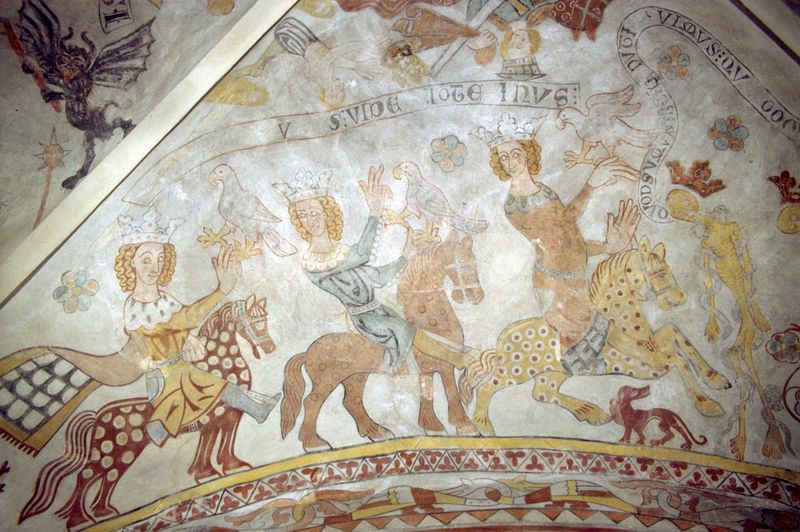
The Middle Ages. Finds of falconry birds in Denmark become more numerous through the Middle Ages 31. According to Gotfredsen, falconry for the Danish kings was as much about keeping falcons as gifts for other royal and princely courts as about hunting themselves 31. The wall paintings in the chancel vault of Skibby Church in Hornsherred date from the first half of the 14th century. They show three crowned kings riding out to hunt, each with a falcon on his hand, who meet three dead kings – a reminder that death awaits everyone 50. The paintings were uncovered and heavily restored in 1855–58. According to the National Museum of Denmark's Danmarks Kirker, their main features are reliable, but details and colours are not necessarily so 50.
The 16th century. According to a research article based on archival sources, King Christian III bought one female gyrfalcon for 15 rixdollars and two males for 9 rixdollars each from his chief official in Iceland in 1557. From the early 1560s the Danish kings sold licences to catch falcons in Iceland, and in 1563 the king's official informed Frederick II that foreign falcon trappers were in the country without permission 51.
The Royal Falconry. The Danish king ruled over Norway and Iceland, where gyrfalcons lived in the wild 35. Crown Prince Christian, later King Christian V, established a royal falconry in Frederiksberg after a journey abroad in 1662–63 that took him, among other places, to the court of Louis XIV 35. Sources give different dates for its foundation: around 1664 36, during the 1660s 35 and 1670 37. According to By og Land, it can be established that the falconry had been built and was in operation around 1670 35. Queen Sophie Amalie had already kept a falcon house in Frederiksberg before this 35. In 1663, 48 falcons were bought in Iceland, but whether they went to the queen's falcon house or to the crown prince's falconry cannot be determined 3536. From 1690 a falconer was sent to Iceland every year to buy falcons 36. The birds – some entirely white – were trained in Frederiksberg and used as gifts to Europe's courts, as far as Lisbon 3637. Falcon keeping ended in 1810 37. One building from the falconry still stands on Falkoner Allé 37. Whether it is a remnant of the original falconry from around 1670 is not fully settled, as the timber framing of its façades is later 35. Three falcons appear in Frederiksberg's coat of arms 35.
↑ Back to top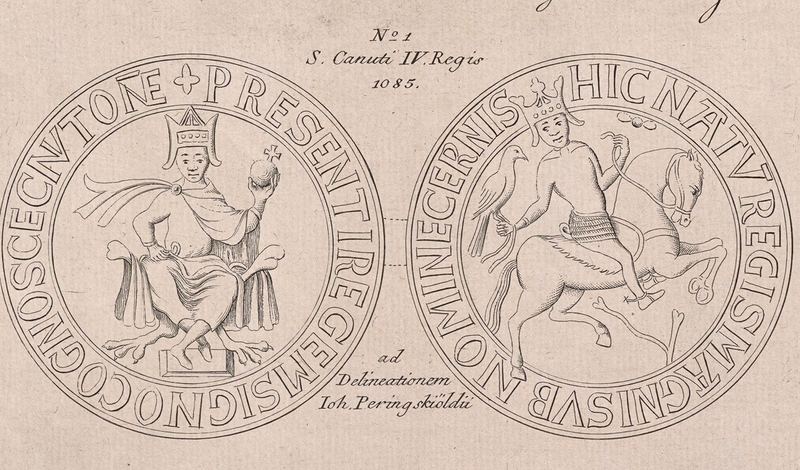
Frank Wenzel and Eagle World
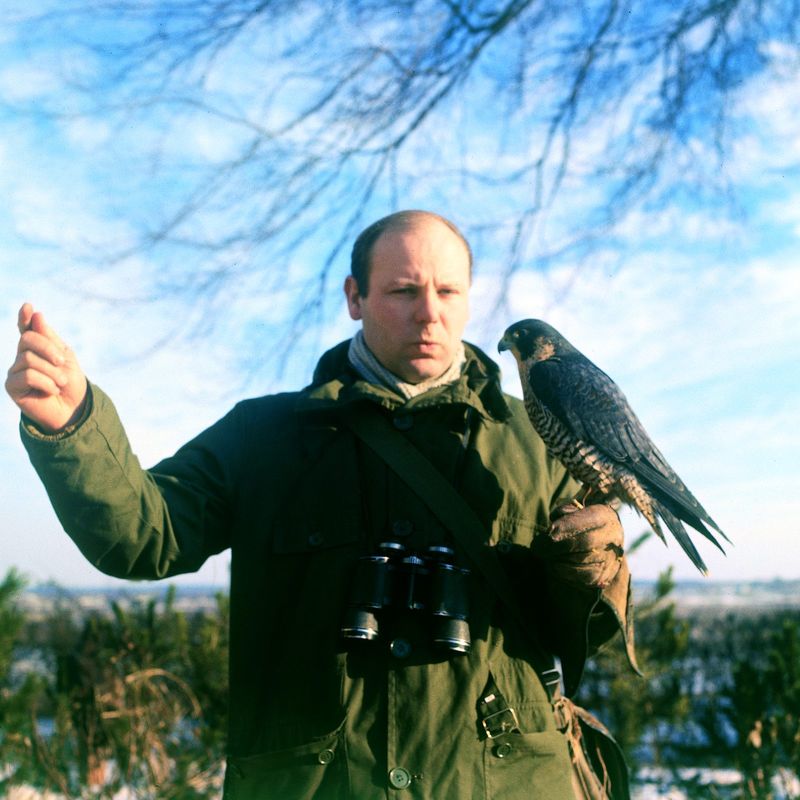
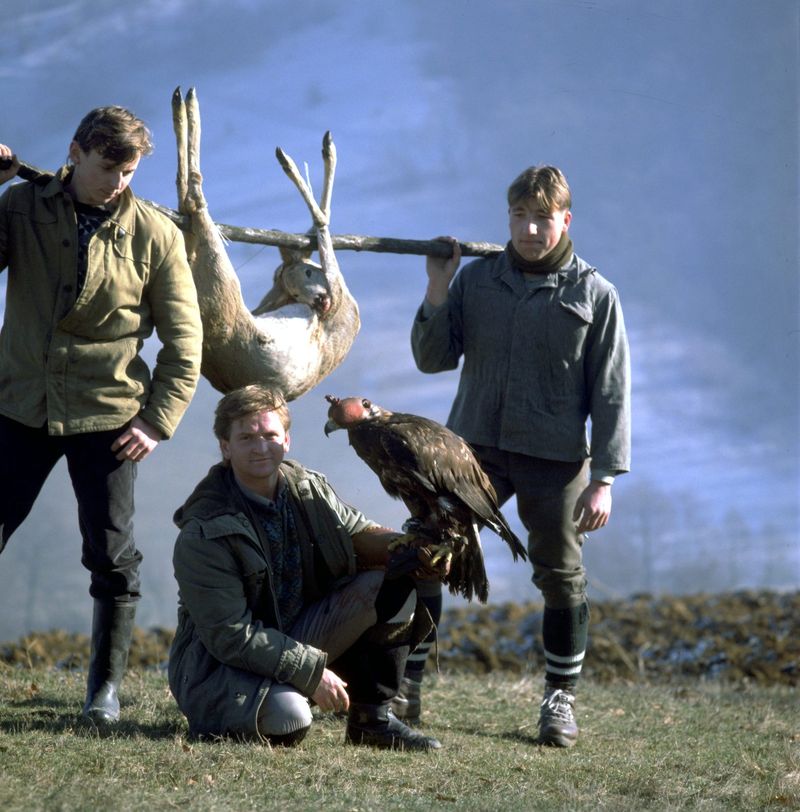
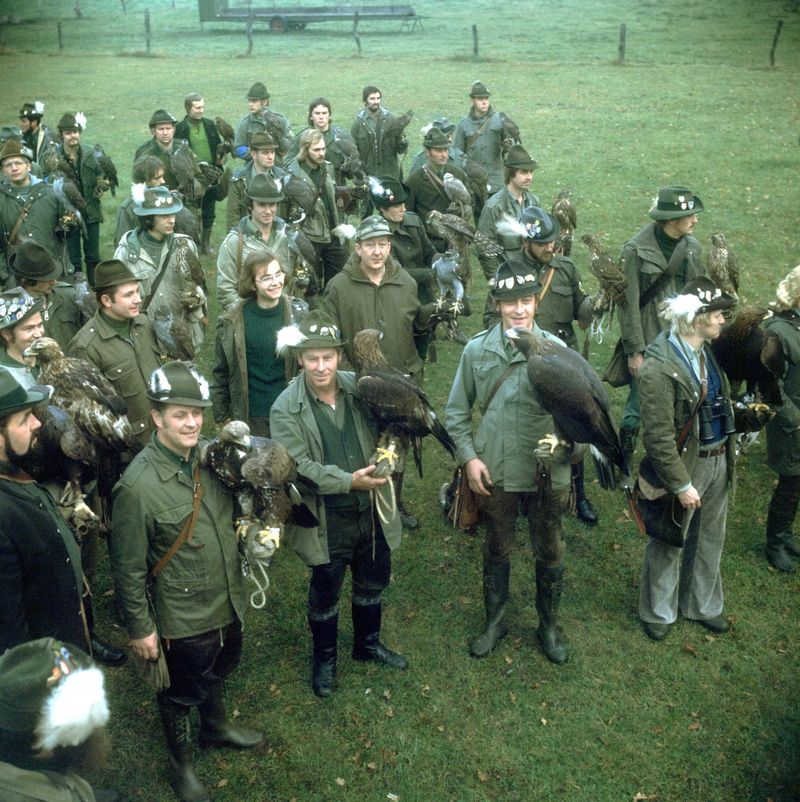
Eagle World (Ørnereservatet) was founded by the falconer Frank Wenzel. Eagle World's archive holds a film from 1965 showing Frank Wenzel hunting at Lake Arresø with his peregrine falcon and his wirehaired pointer. Falconry was practised in Denmark until 1967 3839.
↑ Back to top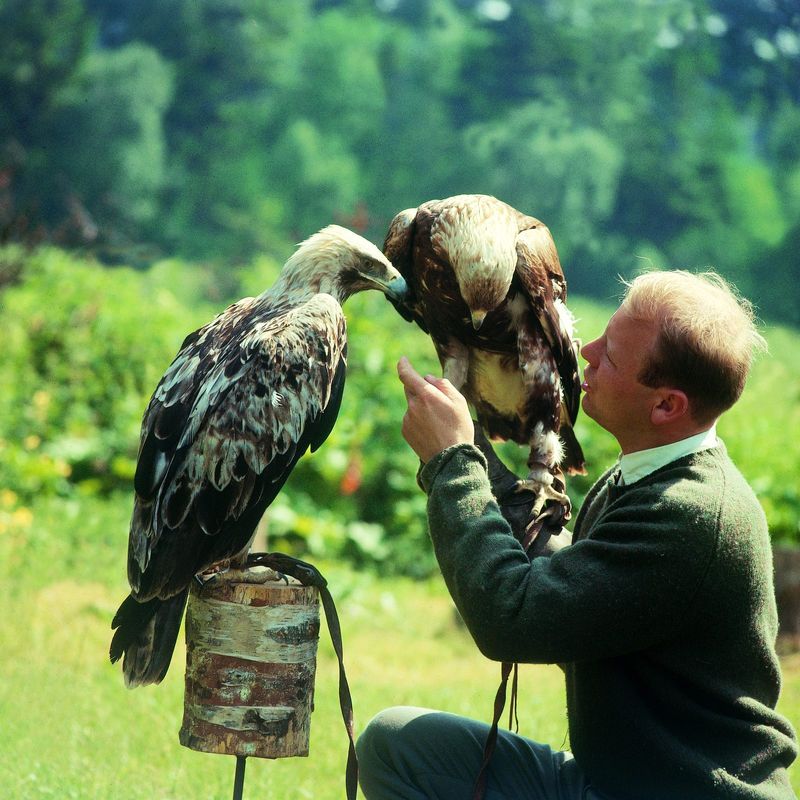
Falconry today
In falconry, it is the bird of prey itself that catches the quarry 13. The IAF describes falconry as a natural method of predation, with a lower rate of take than shooting and a negligible risk of prey escaping injured 9. According to the IAF, the raptors typically catch weak and diseased individuals 10. A study from Croatia compared hunting with five goshawks and with five guns on the same land: the hawks took 9 of 112 game animals flushed, the guns 40 of 110 42.
The German Commission for UNESCO describes the training of a bird of prey as a sensitive process in which the bird slowly becomes accustomed to its falconer through positive experiences and rewards. Punishment is never used, because birds of prey do not understand it 13.
Falconers' knowledge has also mattered for conservation. When the peregrine falcon declined severely because of pesticides such as DDT, the major breeding and release programmes in the USA and Europe were led by falconer-biologists such as Tom Cade and Christian Saar 9. The Peregrine Fund, founded in 1970, released over 4,000 captive-raised peregrines in 28 US states, and in 1999 the species was removed from the US Endangered Species List 4041.
↑ Back to top
Children, nature and generations
UNESCO stresses that falconry is passed on between generations – within families, through mentoring and in clubs 1. The 2010 decision notes that falconers in, among other countries, Mongolia, Morocco, Qatar, Saudi Arabia and the United Arab Emirates take their children out and teach them to handle the bird and build a relationship of trust with it 2. The German Commission for UNESCO points out that falconry cannot be learned from theory alone; it requires experience with living animals, patience and empathy 13.
Research on children and nature points to positive associations. A systematic review of 296 studies in the journal Pediatrics (2021) found a positive relationship between children's contact with nature and their health, especially physical activity and mental health 43. A meta-analysis from the University of Edinburgh found a moderate positive association between nature connection and wellbeing in children and adolescents 44. The researchers stress that most studies show associations and cannot establish cause and effect 4344.
↑ Back to topQuotes on falconry
Quotations originally in other languages are given in Eagle World's own translation and marked "translated".
"Its usefulness is great. For the noble and powerful, burdened with the government of worldly affairs, will through the practice of this art often set joys between their cares. […] And both [rich and poor] will through this art gain a revelation of the workings of nature in birds."
Queen Margaret: "Believe me, lords, for flying at the brook / I saw not better sport these seven years' day"
King Henry: "But what a point, my lord, your falcon made, / And what a pitch she flew above the rest! / To see how God in all His creatures works!"
"…as he goes there is many a fine sight to be seen, and plenty of the very best entertainment in hawking; in fact, there is no sport in the world to equal it!"
The companionship of a hunting party "…permits each and every member of the expedition to speak freely and express his ideas and viewpoints without inhibition and restraint, and allows the one responsible to acquaint himself with the wishes of his people, to know their problems and perceive their views accurately, and thus to be in a position to help and improve their situation."
"I think most falconers simply want to watch these birds do what they do in the wild, but close-up. It's a privilege. […] So falconry is about controlling your own needs and your own body in favor of this creature. You disappear, really. The only thing that's important is the bird."
Sources
- UNESCO: Falconry, a living human heritage – https://ich.unesco.org/en/RL/falconry-a-living-human-heritage-01708
- UNESCO, decision 5.COM 6.45 (2010) – https://ich.unesco.org/en/decisions/5.COM/6.45
- UNESCO, decision 7.COM 11.33 (2012) – https://ich.unesco.org/en/decisions/7.COM/11.33
- UNESCO, decision 11.COM 10.b.15 (2016) – https://ich.unesco.org/en/decisions/11.COM/10.b.15
- UNESCO, decision 16.COM 8.b.14 (2021) – https://ich.unesco.org/en/decisions/16.COM/8.b.14
- UNESCO: Find out the newly inscribed elements on the 2003 Convention Lists (17.12.2021) – https://ich.unesco.org/en/news/find-out-the-newly-inscribed-elements-on-the-2003-convention-lists-13359
- UNESCO nomination file no. 01708 (2021) – https://www.cultura.gob.es/dam/jcr:c0f30899-f85f-46e2-b7e9-c0d18fbd9bb5/51064-en.pdf
- IAF: UNESCO & Falconry – https://iaf.org/unesco-falconry
- IAF: Falconry today – https://iaf.org/falconry-today
- IAF: Legislation – https://iaf.org/legislation
- Österreichische UNESCO-Kommission: Extensions on the Representative List – Transhumance & Falconry – https://www.unesco.at/en/culture/intangible-cultural-heritage/news/article/extensions-on-the-representative-list-transhumance-falconry
- The National (17.12.2021): Unesco Intangible Heritage list: falconry expanded – https://www.thenationalnews.com/arts-culture/2021/12/17/unesco-intangible-heritage-list-falconry-expanded-joumou-soup-and-congolese-rumba-added/
- Deutsche UNESCO-Kommission: Falknerei in Deutschland – https://www.unesco.de/staette/falknerei-in-deutschland/
- Martial's hawk and Iberian falconry. An exception in the ancient world, Anthropozoologica 57 (2022) – https://doi.org/10.5252/anthropozoologica2022v57a5
- Falconry in central Europe in the Middle Ages, Anthropozoologica (1993) – https://sciencepress.mnhn.fr/sites/default/files/articles/pdf/az1993hs1a34.pdf
- T. Soma: Ethnoarchaeology of Ancient Falconry in East Asia (Asian Conference on Cultural Studies 2013) – https://www.academia.edu/90515031/Ethnoarchaeology_of_Ancient_Falconry_in_East_Asia
- Shaanxi History Museum: Hunting procession mural, tomb of Prince Zhanghuai – https://www.sxhm.com/collections/detail/515.html
- Kanazawa University: Archeological Evidence for a Cultural History Study of Takakai – https://kanazawa-u.repo.nii.ac.jp/records/5604
- Kyoto National Museum: Male Haniwa Figurine – https://www.kyohaku.go.jp/eng/collection/meihin/kouko/item05/
- C. Ellis & S. Ottewill-Soulsby: The caliph and the falcons: a ninth-century history from Iceland to Iraq, Early Medieval Europe 34 (2026) – https://www.diva-portal.org/smash/get/diva2:2103862/FULLTEXT01.pdf
- The Travels of Marco Polo, vol. 1 (transl. H. Yule, 3rd ed. rev. H. Cordier, 1903), Project Gutenberg – https://www.gutenberg.org/ebooks/10636
- Materials and techniques used for the "Vienna Moamin", npj Heritage Science (2021) – https://heritagesciencejournal.springeropen.com/articles/10.1186/s40494-021-00553-w
- Biblioteca Apostolica Vaticana, Pal. lat. 1071 – https://digi.vatlib.it/mss/detail/Pal.lat.1071
- Harvard Art Museums: Khan 'Alam, Mughal Emperor Jahangir's Falconer and His Ambassador to Iran – https://harvardartmuseums.org/art/217081
- Cleveland Museum of Art: Akbar and Jahangir Examine a Ghir Falcon – https://www.clevelandart.org/art/2013.317
- M. Vretemark: Birds of prey as evidence for falconry in Swedish burials and settlements (550–1500) – https://www.academia.edu/117342691/
- Brepols: European Graves (c. AD 500–1000) with Raptor Bones and Raptor Imagery Revisited – https://www.brepolsonline.net/content/books/10.1484/M.TANE-EB.5.151505 · and chapter by E. Hagen – https://www.brepolsonline.net/content/books/10.1484/M.TANE-EB.5.151506
- Sciencenorway (26.03.2022): The Norwegian medieval kings were known to give the best gifts: Falcons – https://www.sciencenorway.no/archaeology-birds-history/the-norwegian-medieval-kings-were-known-to-give-the-best-gifts-falcons/1993045
- Store norske leksikon: Alstadsteinen – https://snl.no/Alstadsteinen
- Heroic images on runestones in the context of commemoration and communication – https://core.ac.uk/download/55810542.pdf
- A.B. Gotfredsen: Fuglefangstens rolle i sen jernalder og vikingetid i Danmark (University of Copenhagen) – https://researchprofiles.ku.dk/da/publications/db36586e-4949-4083-b6f2-35ed6c8c7a34
- A.B. Gotfredsen: Traces of falconry in Denmark from the 7th to 17th centuries (2018) – https://researchprofiles.ku.dk/en/publications/traces-of-falconry-in-denmark-from-the-7supth-supto-17supthsup-ce/
- Birds in Subsistence and Culture at Viking Age Sites in Denmark, Int. J. Osteoarchaeology (2013) – https://doi.org/10.1002/oa.2367
- Danmarkshistorien (Lex): Knud den Hellige – https://danmarkshistorien.lex.dk/Knud_den_Hellige,_ca._1042-1086
- By og Land: Falkonergården på Frederiksberg – https://byogland.dk/by-land/et-historisk-og-et-nutidigt-tagnhus-2/
- Falkoneren: Falkonergårdens falke havde enorm betydning for det danske rige – https://falkoneren.dk/article/kender-du-historien-falkonergaardens-falke-havde-enorm-betydning-det-danske-rige
- Netværk for Bindingsværk: Falkonergården på Frederiksberg – https://www.netvaerkforbindingsvaerk.dk/post/falkonerg%C3%A5rden-p%C3%A5-frederiksberg
- Dansk Falkejagt Klub: Historie – https://danskfalkejagtklub.dk/historie
- Danmarks Jægerforbund (2018): Første stykke vildt nedlagt med rovfugl – https://www.jaegerforbundet.dk/om-dj/dj-medier/nyhedsarkiv/2018/forste-stykke-vildt-nedlagt-med-rovfugl/
- The Peregrine Fund: Peregrine Falcon Delisted! (1999) – https://peregrinefund.org/news-release/peregrine-falcon-delisted
- The Peregrine Fund: History – https://peregrinefund.org/history
- A comparison of falconry and hunting with guns with respect to the distribution of local game, Wildlife Biology (2008) – https://doi.org/10.2981/0909-6396(2008)14[125:acofah]2.0.co;2
- Nature and Children's Health: A Systematic Review, Pediatrics 148 (2021) – https://publications.aap.org/pediatrics/article-abstract/148/4/e2020049155/181269/
- University of Edinburgh: Nature connection and wellbeing in children and adolescents: a systematic review and meta-analysis – https://www.research.ed.ac.uk/en/publications/nature-connection-and-wellbeing-in-children-and-adolescents-a-sys/
- Hrólfs saga kraka ok kappa hans (Old Norse text), heimskringla.no – https://heimskringla.no/wiki/Hr%C3%B3lfs_saga_kraka_ok_kappa_hans
- Skaldic Poetry of the Scandinavian Middle Ages: Prose source – Hrólfs saga kraka (introduction and manuscripts) – https://skaldic.ku.dk/q?p=skp%2Ftexts%2Ftext%2F73
- Saxo Grammaticus: The Danish History, Books I–IX (transl. O. Elton, 1905), Book 2, Project Gutenberg – https://www.gutenberg.org/ebooks/1150
- Jómsvíkinga saga, ch. 5 (Old Norse text), Netútgáfan – https://netutgafan.snerpa.is/forn/jomsvik.htm
- Store norske leksikon: Jómsvíkinga saga – https://snl.no/J%C3%B3msv%C3%ADkinga_saga
- Danmarks Kirker (Nationalmuseet): Skibby Kirke, Frederiksborg Amt, pp. 2641–2703 – https://nmdanmarkskirkerprod.blob.core.windows.net/files/Frederiksborg_2641-2703.pdf
- N. Mehler, H.C. Küchelmann & B. Holterman: The export of gyrfalcons from Iceland during the 16th century, in Raptor and human, vol. 2 (ZBSA 2018) – https://www.knochenarbeit.de/wp/wp-content/uploads/Mehler_etal_2018_gyrfalcons.pdf
- Frederick II: De arte venandi cum avibus, prologue (Latin text), Bibliotheca Augustana – https://hs-augsburg.de/~harsch/Chronologia/Lspost13/FridericusII/fri_arsp.html
- W. Shakespeare: Henry VI, Part 2, act 2, scene 1, in The Complete Works of William Shakespeare, Project Gutenberg – https://www.gutenberg.org/ebooks/100
- WAM – Emirates News Agency (2005): Zayed – 'Father of the Nation' – https://www.wam.ae/en/article/hsyifwpl-zayed-039father-the-nation039 · UAE Interact: Sheikh Zayed bin Sultan Al Nahyan – a special tribute – https://uaeinteract.com/uaeint_misc/pdf_2005/zayed_tribute/zayed.pdf
- E. Bryce: Helen Macdonald on What Falconry Can Teach Us About Our Relationship With Raptors, Audubon Magazine (25.01.2022) – https://www.audubon.org/magazine/helen-macdonald-what-falconry-can-teach-us-about-our-relationship-raptors
- Þjóðminjasafn Íslands / National Museum of Iceland: Making of a Nation – The Valþjófsstaðir door, 1175–1200 (Þjms. 11009/1930-425) – https://thjodminjasafn.is/en/syningar-og-vidburdir/thjod-verdur-til